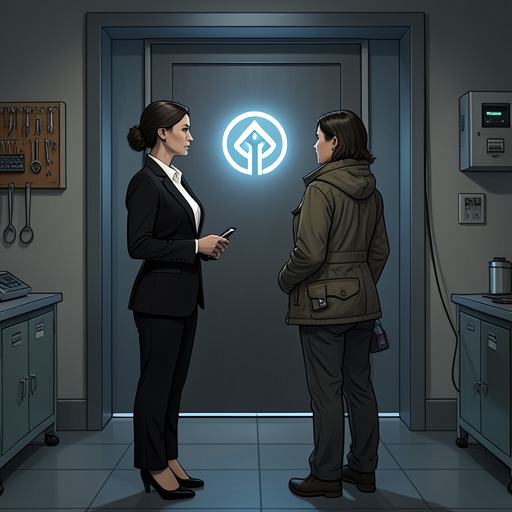
Samurai Family
Tinea and Leah: [Cyberpunk, Alien Incursions, Murder and Mayhem, Girl's Love (WLW)]Samurai Family is a distributed support network whose importance becomes clearest when war, trauma, and distance make ordinary community structures unreliable. It links Leah, Tinea, Sun, Jem, the children, Ypsilon, Tynea, and other samurai through secure communication and shared resources, functioning simultaneously as a family-like social network, an emergency information system, and a source of psychological guidance. Its tools do not replace personal judgment; they give endangered people enough information and support to make decisions for themselves.
Nature and Functions
Samurai Family operates through digital applications and connected artificial intelligences rather than a single visible headquarters. Its Family app can carry alerts and facilitate contact, while its mental-health resources provide members with access to psychological knowledge. The organization therefore combines social intimacy with technical infrastructure: a person can remain connected to loved ones, receive warnings about changing danger, and consult specialized guidance without being physically near the rest of the network.
The network is also embedded in the wider samurai information environment. Tinea's augmented systems can identify people in view, organize their names, and present information through visual and auditory overlays; elsewhere, maps and screens display the spread of Antithesis hordes. Samurai Family belongs to this same world of interface-mediated coordination, but its purpose is not merely surveillance or combat efficiency. It makes communication and care actionable during a crisis in which roads, shelters, and ordinary institutions are under pressure.
Family Communication During the Incursion
During the global Antithesis incursion, the Family app became a practical channel for coordinating risk. Leah had sent a low-priority alert, and Ypsilon had installed the relevant application for her. Leah and Tinea reviewed the alert while examining a large Antithesis swarm and deciding that diverting resources to isolated single-digit units would be less useful than preparing for the larger threat and the approaching storm. The app thus supported tactical judgment without dictating it: the situation remained low priority because the horde was moving slowly and was not expected to reach humans immediately.
The same network preserved contact between separated households. When Leah re-established a call with Sun, Sun reported that the children were safe from the incursions and that New Montreal was building a substantial wall while maintaining surprisingly positive morale. Jem had investigated Leah's disappearance after she failed to appear, detected tampering on her door, and helped the household infer that she had probably been taken against her will. Leah could then warn them that she and another new samurai had been kidnapped, advise them not to travel alone, and ask them to report anything suspicious immediately. Ypsilon was expected to ensure rapid contact for as long as the internet connection survived.
This exchange shows Samurai Family working as both kinship and emergency governance. It does not erase the dangers of the wider disaster: Antithesis ropes crash into the outskirts of a suburb, destroy houses, crush vehicles, and block the entrance to a community shelter, while military bases attempt to funnel the invading hordes back into a cordon. Against that scale of violence, the Family's contribution is comparatively intimate but consequential. It keeps people informed, confirms who is safe, and converts private observations into warnings that can guide collective survival.
Mental-Health Care and the Limits of Dependence
Samurai Family's mental-health resources become especially important in the handling of Leah's trauma. During a flashback, Tinea asks what to do while Leah sobs without responding. Tynea, with Ypsilon's agreement, identifies the episode and advises Tinea to remain calm, avoid seeking additional physical contact, speak gently, remind Leah that she is experiencing a flashback, and encourage slow, deep breathing. The guidance treats immediate safety and control as priorities rather than assuming that affection or forceful intervention will automatically help.
The Family's psychological assistance also establishes boundaries for long-term care. When Tinea asks how to prevent another episode, the advice is that no partner can simply eliminate the condition. Tinea can learn Leah's triggers and avoid presenting them, but Leah must gradually become able to rely on her own person, while professional care—not a romantic partner—must address her health. This principle matters because intimate protection can quietly become infantilization: care that appears loving may undermine autonomy by treating an adult as incapable of managing decisions or distress.
Tinea later learns that Leah can warn her when an episode is approaching. Leah explains that Tinea should talk to her, wait patiently for answers, and focus on keeping her safe and comfortable while the episode runs its course. Samurai Family therefore supports a negotiated care protocol rather than a one-sided rescue script. The affected person retains knowledge of her own experience, the partner receives practical instructions, and both are given a framework that reduces panic without pretending that trauma can be solved by devotion alone.
Membership, Trust, and Technical Mediation
Samurai Family's reach depends on trust as much as on hardware. Its communications can be protected from listeners and recording, allowing members to disclose kidnapping, suspected corporate wrongdoing, and household security concerns. That protection is especially valuable in a world where drones inspect neighborhoods, unknown hovervans conduct quiet surveillance, and organizations seek information about newly emerged samurai. The Family app becomes a counterweight to hostile observation: it gives vulnerable people a channel in which sensitive knowledge can be shared deliberately rather than exposed indiscriminately.
The network also blurs the boundary between human and artificial membership. Ypsilon helps install the application and maintain rapid contact, while AI-I accesses a Family mental-health AI to investigate the meaning and implications of infantilization. The result is not a simple human organization using neutral tools. Human members, artificial assistants, databases, maps, alerts, and communication links jointly produce the network's capacity to act. Artificial intelligence can sort information and offer clinical explanation, but the emotional and ethical consequences still return to people such as Tinea and Leah.
Narrative and Thematic Significance
Samurai Family represents a form of collective resilience distinct from the spectacular violence of older and stronger samurai destroying Antithesis by the thousands. Its power appears in quieter operations: an application installed before it is urgently needed, a low-priority alert evaluated against a changing battlefield, a missing person's household checking a damaged door, a secure call confirming that children are safe, and a mental-health system teaching a partner when not to touch.
Its most significant tension is between protection and autonomy. The Family can make people more visible to one another, preserve contact across dangerous distances, and provide knowledge that a traumatized person or frightened partner may not possess alone. Yet the organization's own care ethic insists that support must not become total control. By directing Tinea toward patience, professional treatment, and respect for Leah's independent personhood, Samurai Family defines belonging not as surrendering agency but as receiving enough structured help to keep it.